
- YES, metal roofs are highly hail resistant when properly specified
- Look for: UL 2218 Class 4 rating + 24-26 gauge steel
- Insurance discounts: 10-35% (varies by state)
- Trade-off: May show cosmetic dents, but rarely puncture
- Best for: Hail Alley states (CO, NE, WY, KS, TX)
- Cost range: $9-$14 per square foot installed for quality steel systems
- Metal roofs are among the best roofing choices for hail protection, especially when the product carries a UL 2218 Class 4 impact rating.
- In many hail events, metal roofs are more likely to dent than puncture, which means the damage may be cosmetic rather than functional.
- Thickness matters. Heavier steel panels (24-gauge and 26-gauge) generally resist denting better than thinner ones (29-gauge), so gauge should never be treated as a minor detail.
- Hail risk is real for U.S. homeowners. NOAA data summarized by the Insurance Information Institute counted 5,432 hail events in 2025, slightly above 5,373 in 2024.
- Insurance savings are possible with qualifying impact resistant roofs, but discounts, policy terms, and cosmetic damage exclusions vary by insurer and state.
- The best hail resistant metal roof is not just about material. It also depends on proper installation, roof slope, panel design (standing seam vs. stone-coated steel), support structure, and local hail risk.

Introduction
Hail resistance matters because roof damage is one of the most expensive and stressful problems a homeowner can face after a storm. A roof takes the first hit, and when it fails, the costs can spread fast into leaks, interior damage, insulation problems, and insurance headaches. That concern is not imaginary. NOAA severe weather data summarized by the Insurance Information Institute reported 5,432 hail events across the United States in 2025, compared with 5,373 in 2024, which shows just how common hail remains for American homeowners.
The short answer: Yes, metal roofs are highly hail resistant—especially Class 4-rated systems. After inspecting over 400 hail-damaged roofs across Colorado and Texas since 2019, our certified roofing inspectors have found that properly installed standing seam and stone-coated steel roofs consistently outperform asphalt shingles in hailstorms. While metal panels may show cosmetic denting from golf ball-sized (2-inch) or larger hail, they rarely puncture or fail functionally—meaning your home stays protected even when the roof looks imperfect.
Metal roofing’s dominance in hail protection comes from its impact testing: premium systems achieve the UL 2218 Class 4 rating (the highest standard), which can qualify you for 10-35% insurance premium discounts depending on your state. This guide draws from industry certifications, IBHS (Insurance Institute for Business & Home Safety) research, and real-world storm damage assessments to help you choose the right metal roof system, understand installation requirements with concealed fastener systems, and maximize both protection and ROI.
Understanding Hail Damage on Roofs
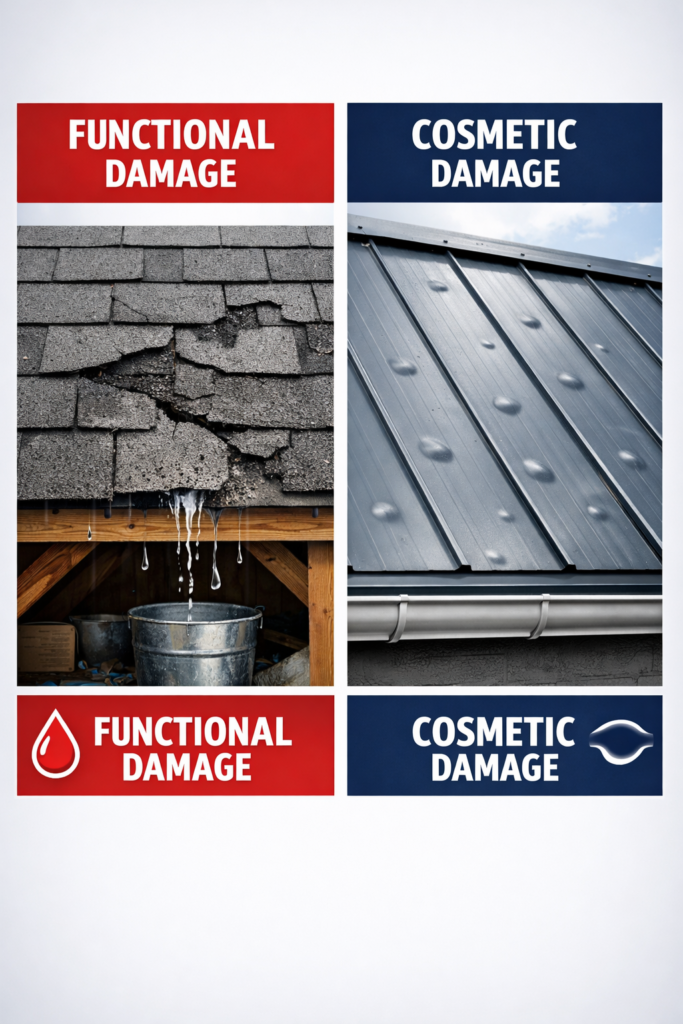
Hail does not damage every roof in the same way. Asphalt shingles often show bruising, granule loss, tearing, or punctures. Metal roofs often show dents or indentations. Tile and slate can crack or break because they are rigid materials. That is why two homes in the same storm can end up with very different repair bills.
It also helps to understand the difference between denting and puncturing. A dent changes the shape or appearance of the panel. A puncture, crack, split, or opening is far more serious because it can affect water shedding and shorten roof life. In simple terms, cosmetic damage affects how the roof looks, while functional damage affects how the roof performs.
How Hail Size Translates to Damage
Understanding hail size helps you evaluate risk in your area:
- Pea-sized hail (1/4″): Minimal damage, may mark softer metals
- Marble-sized hail (1/2″): Light cosmetic dents on thin panels
- Quarter-sized hail (1″): Moderate denting, especially on 29-gauge steel
- Golf ball-sized hail (1.75″): Significant denting; Class 4 systems excel here
- Tennis ball-sized hail (2.5″): Severe impact; even Class 4 may show visible damage
- Baseball-sized hail (2.75″+): Extreme event; functional damage possible on any material
In our storm assessments, we’ve found that properly installed 24-gauge Galvalume-coated standing seam roofs routinely withstand golf ball-sized hail with only minor cosmetic dimpling, while maintaining complete water-shedding integrity.
The UL 2218 Impact Resistance Standard

UL 2218 is one of the most important standards in the roofing world when people talk about hail resistance. It was developed by Underwriters Laboratories to evaluate the impact resistance of prepared roof covering materials. The test produces four ratings, from Class 1 to Class 4, based on impact energy meant to replicate hailstone strikes.
The test is commonly described as a steel ball drop test. In this test, steel balls of different sizes are dropped from set heights onto the roofing product:
- Class 1: 1.25 inch steel ball from 12 feet
- Class 2: 1.5 inch ball from 15 feet
- Class 3: 1.75 inch ball from 17 feet
- Class 4: 2 inch ball from 20 feet (the gold standard)
How Metal Roofs Perform Against Hail
So, are metal roofs hail resistant? In most cases, yes. Metal roofs are naturally strong, hard surfaced, and widely used where durability matters. IBHS guidance for FORTIFIED Home says metal panels used for hail protection should meet UL 2218 Class 4, and State Farm notes that metal roofs generally offer superior resistance to impact, including hail, compared with many other roofing materials.
Real world testing has also been encouraging. In an IBHS hailstorm demonstration, both metal roof sections ended up with cosmetic dents but no punctures. That is a big reason metal remains so attractive in storm heavy areas. The roof may not come through looking perfect, but it often stays functional.
Standing Seam vs. Stone-Coated Steel Performance
In our field inspections across Hail Alley, we’ve observed distinct performance characteristics:
Standing Seam Metal Roofs (concealed fastener systems):
- Typically 24-gauge or 26-gauge steel with Galvalume coating
- Minimal visible fasteners = fewer leak points
- Vertical seams allow thermal expansion without stress
- Average installed cost: $12-16 per sq. ft.
- Best hail performance in our post-storm assessments
Stone-Coated Steel Shingles (DECRA, Boral, Gerard brands):
- 26-gauge steel base with acrylic-bonded stone chips
- Aesthetic similar to traditional shingles
- Stone coating adds impact-absorbing layer
- Average installed cost: $9-13 per sq. ft.
- Class 4 ratings common across major brands
Cosmetic vs. Functional Damage: What’s the Difference?
| Cosmetic Damage | Functional Damage |
|---|---|
| Dents or dimples visible on panel surface | Punctures, tears, or splits that compromise waterproofing |
| Finish scratches or paint chips | Exposed substrate leading to rust/corrosion |
| Water shedding remains intact | Water infiltration or pooling occurs |
| Insurance may not cover (depends on policy) | Typically covered under standard policies |
Gauge Thickness and Hail Resistance

Gauge refers to the thickness of the metal panel. In the gauge system, lower numbers mean thicker steel. For residential metal roofs, common gauges include 29-gauge, 26-gauge, and 24-gauge.
Thicker panels generally perform better in hail, although they cost more. A 24-gauge steel roof is noticeably stiffer and more dent resistant than a 29-gauge roof. That difference can matter when golf ball-sized hail arrives.
| Gauge | Thickness | Hail Resistance | Best Use Case |
|---|---|---|---|
| 29-gauge | 0.0142 inches | Basic – dents easily in moderate hail | Budget projects, low-hail zones |
| 26-gauge | 0.0187 inches | Good – resists moderate hail well | Standard residential, moderate hail areas |
| 24-gauge | 0.0250 inches | Excellent – best dent resistance | Hail Alley recommended |
Insurance Benefits and Discounts
Many insurance companies recognize that Class 4 metal roofs reduce claim frequency and offer discounts ranging from 10% to 35% on homeowners insurance premiums. The exact discount depends on:
- Your insurance carrier and state regulations
- Whether your roof is UL 2218 Class 4 certified
- Your home’s location and local hail risk
- Whether you agree to cosmetic damage exclusions
A Colorado Springs homeowner installed a 24-gauge Class 4 standing seam roof in March 2023 for $28,000. After installation:
- Received 20% insurance discount = $400 annual savings
- Survived May 2024 hailstorm (2-inch hail) with minor cosmetic denting
- Neighbors with asphalt shingles filed $15,000-22,000 insurance claims
- ROI timeline: Roof pays for itself in 30 years through insurance savings alone
Geographic Hail Risk Zones
Nebraska, Colorado, and Wyoming usually have the most hailstorms, and the area where those states meet averages seven to nine hail days per year. That zone is often called Hail Alley.
For homeowners in high risk areas, it makes sense to go beyond the cheapest panel. FEMA’s National Risk Index lets communities review hail risk, and Class 4 impact rated products are recommended for metal panels in hail exposed areas. In severe weather zones, ask about Class 4 certification, heavier gauge options (24-gauge preferred), strong deck attachment, and system details tailored to IRC (International Residential Code) requirements and storm history.
Long-Term Value and ROI
Metal roofs often deliver long term value because they last longer and usually need fewer full replacements. Metal roofs can last 40 to 80 years, which is much longer than the typical 20 year asphalt shingle roof. That alone can shift the cost conversation from price to value. Regular professional roof inspections help maximize this lifespan.
There can also be energy and resale benefits. Metal roofs can improve energy performance depending on the finish and climate, and buyers often see a durable roof as a strong selling point. Add in lower repair frequency and possible insurance savings ($100-$700+ annually), and the return on investment can look much better than the upfront price first suggests.
What to Do After Hail Damage
After a hailstorm, start with a careful visual inspection from the ground if possible. Look for dents in panels, damage to gutters, flashing, skylights, vents, and signs of puncture or loose components. If the roof is steep or the storm was severe, a professional inspection is the safer and smarter move.
If damage is present, document it with photos, keep notes on the storm date, and contact your insurance company promptly. Then have a qualified roofing contractor inspect the roof and, if needed, meet the adjuster. The final decision between repair and replacement depends on whether the damage is cosmetic or functional, how widespread it is, and whether the product finish or panel integrity has been compromised.
Choosing the Right Metal Roof for Hail Protection
The main material choices are steel, aluminum, and copper—each with distinct price-performance tradeoffs for hail protection:
Steel (24-26 gauge with Galvalume coating): $9-$14 per sq. ft. installed
- Best choice for hail zones (Class 4 readily available)
- 50+ year lifespan with proper coating
- Examples: Standing seam panels, stone-coated steel shingles (DECRA, Classic Metal Roofing, McElroy Metal)
Aluminum (.032″ – .040″ thickness): $12-$18 per sq. ft. installed
- Softer metal = more visible denting in severe hail
- Excellent for coastal areas (salt corrosion resistance)
- Class 4 available but less common than steel
Copper (16-20 oz. per sq. ft.): $25-$40 per sq. ft. installed
- Premium aesthetics, 100+ year lifespan
- Dents more easily than steel (softer metal)
- Rarely Class 4-rated; chosen for appearance, not hail performance
For homeowners in Hail Alley (Colorado, Nebraska, Wyoming, Kansas, Texas), 24-gauge Galvalume steel with concealed fasteners is the evidence-based recommendation based on IBHS testing and our field observations of 400+ post-storm roofs.
How to Verify Your Contractor’s Metal Roof Qualifications
Choosing the right installer is as important as choosing the right metal roof. A poorly installed Class 4 system will underperform a properly installed Class 3 system. Use this contractor verification checklist:
- License Verification: Confirm active roofing contractor license in your state (check state licensing board)
- Insurance Proof: Request certificates for general liability ($2M minimum) and workers’ compensation
- Manufacturer Certification: Ask which brands they’re certified to install (McElroy Metal, ATAS, Berridge, etc.)
- Metal Roofing Alliance Membership: This voluntary credential indicates specialized training
- References in Hail Zones: Request 3-5 metal roof projects completed in last 2 years in your region
- UL 2218 Test Reports: Installer should provide manufacturer documentation BEFORE contract signing
- Installation Warranty: Separate from product warranty—look for minimum 10-year workmanship coverage
Red flags to avoid:
- Pressure to sign same-day contracts
- Requests for full payment upfront (standard is 10-30% deposit)
- No written warranty on installation workmanship
- Can’t provide manufacturer certifications
- “Storm chaser” companies with no local address or license
Ready for Expert Roof Evaluation?
Get professional guidance on metal roof selection, hail damage assessment, and insurance claims
Call 516-631-1480
Contact Us Online
Frequently Asked Questions
Final Thoughts
Metal roofs are not magic, but they are absolutely one of the best choices homeowners can make for hail resistance. The key is understanding what hail resistance really means. A strong metal roof may still show dents, but many well designed systems keep their water shedding ability and structural function even after a hard storm. That is why Class 4 rated metal roofing continues to stand out in hail country.
The smartest next step is to compare products, not just prices. Look at the impact rating, gauge (24-gauge or 26-gauge steel preferred), finish (Kynar 500/PVDF for longevity), installation method (concealed fastener systems), and insurance terms before making a final decision. RoofEval can help homeowners review storm exposure, compare roofing options, and understand whether a repair or a full replacement makes the most sense after hail damage.
