
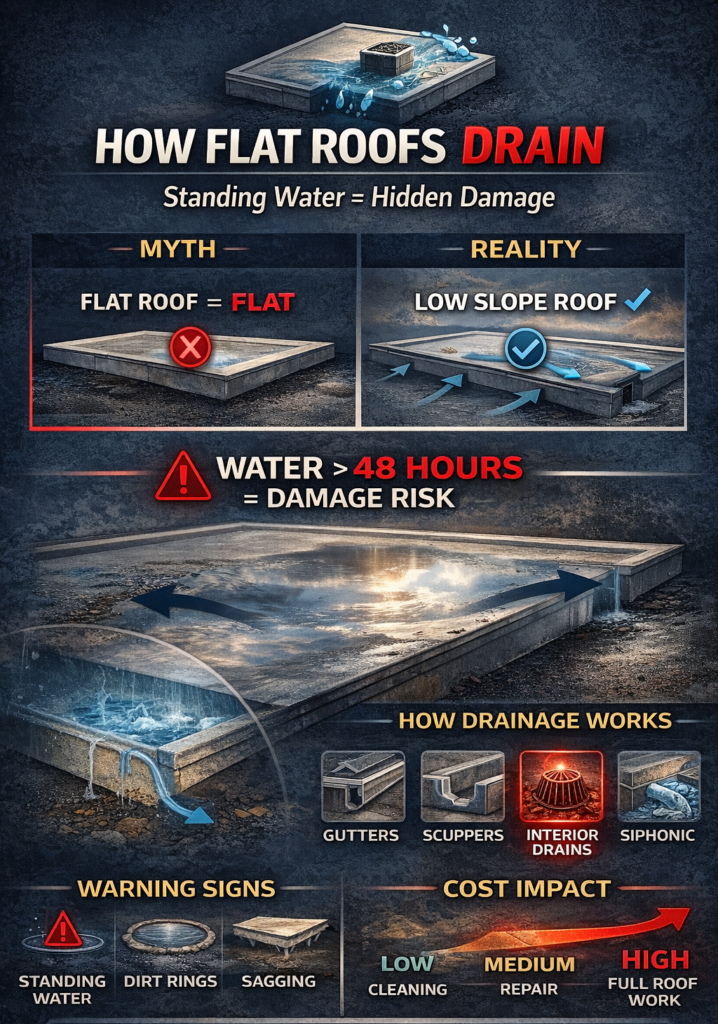
- Not actually flat: Built with gentle slope (typically ¼” per foot) to guide water toward outlets
- 4 main systems: Gutters, scuppers, interior drains, or siphonic drainage
- Key components: Tapered insulation, crickets, primary drains, and overflow protection
- 48-hour rule: Water remaining longer than 48 hours in dry conditions signals drainage problems
- Ponding dangers: Structural stress, membrane damage, insulation saturation, warranty issues
- Maintenance critical: Regular inspections prevent small issues from becoming expensive repairs
- Flat roofs are not truly flat. They are built with a gentle slope that guides water toward drains, scuppers, or gutters so it does not sit on the surface.
- Ponding water is one of the clearest signs that something is wrong. NRCA says water that stays on a low slope roof for more than 48 hours in drying conditions can be harmful to the roof system.
- A flat roof drains well only when design and maintenance work together. Slope, tapered insulation, outlet placement, and overflow protection all matter.
- Small drainage issues can turn into bigger roof problems surprisingly fast. Standing water can lead to leaks, soaked insulation, membrane wear, and extra structural stress.
- Different roofs need different drainage systems. Some use gutters or scuppers, while others depend on interior drains or siphonic systems.
- Repair costs vary a lot depending on how early the problem is found. Basic maintenance may be simple and affordable, while major drainage failure can lead to costly roof work. A professional inspection can catch issues early.
Introduction
One of the biggest myths about flat roofs is that they are supposed to be completely level. That sounds logical at first, but it is actually wrong. A flat roof is really a low slope roof, and that small slope is what makes drainage possible. Without it, rainwater would simply stay in place and collect across the surface. NRCA guidance explains that roof slope and positive drainage matter because ponding water that remains too long can damage the roof assembly.
That is why drainage is one of the main reasons the roof either performs well or starts failing early. A flat roof may look simple from the ground, but under that surface is a carefully planned system that includes slope, insulation, outlets, edge details, and backup drainage paths. When any part of that system stops doing its job, water begins to linger, and once water lingers, problems tend to multiply. Keep reading to understand exactly how a flat roof drains, why ponding happens, which drainage system your building may have, and what these issues can cost to fix.

Why Drainage Is the Number One Priority on a Flat Roof
Drainage matters on every roof, but it matters even more on a flat roof because the roof does not have a steep angle to quickly shed water. On a pitched roof, rainwater usually flows off fast with very little effort. On a flat roof, the movement is slower and depends much more on precise design. That means even a small problem, like debris near a drain or a slight low spot in the insulation, can affect how water leaves the roof. What looks minor at first can become the start of repeated ponding after every storm.
This is why professionals treat drainage as a priority, not an afterthought. A flat roof can have a strong membrane and quality materials, but if water has nowhere to go, the rest of the system is under constant stress. The roof has to resist water, weight, temperature changes, and wear all at the same time. Good drainage reduces that burden. Poor drainage increases it every time it rains.
What Is Ponding Water?
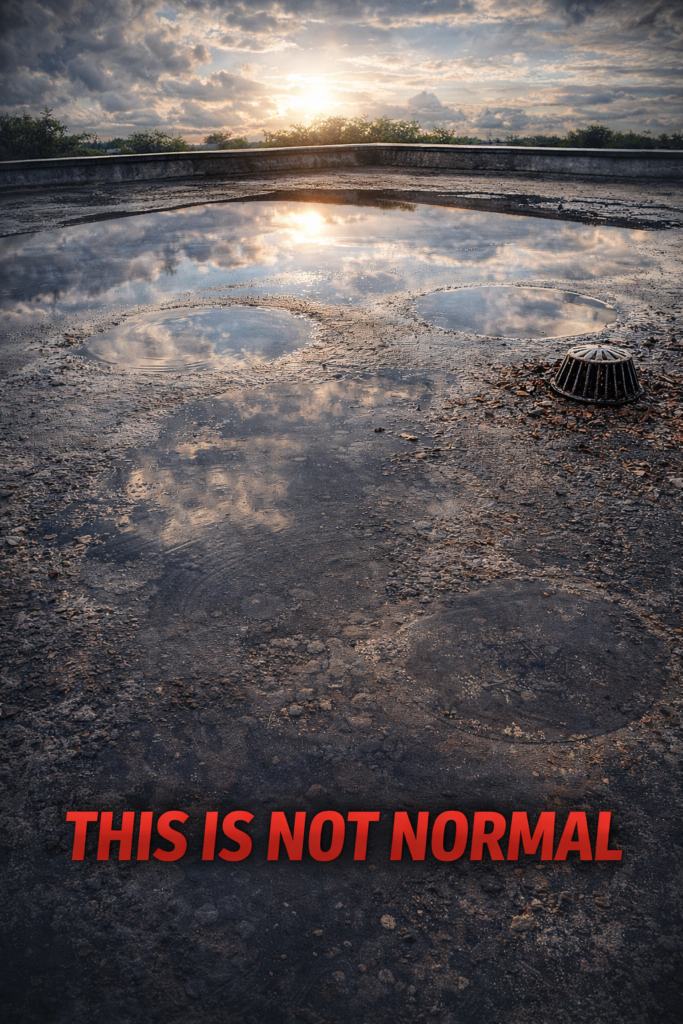
Ponding water is water that remains on the roof surface instead of draining away within a reasonable time. Many owners think a little standing water is normal because the roof is flat, but that assumption can be dangerous. A roof may briefly hold some water right after a storm, especially during heavy rainfall, yet that water should clear as conditions dry. When it stays too long, it means the roof is not draining the way it should.
Ponding often forms in the same areas again and again. That is why you may notice dirt rings or stained patches in certain spots. These repeated puddles are not random. They usually point to a low area, clogged outlet, sagging section, or a drainage design that is no longer performing properly.
The 48-Hour Rule Every Owner Should Know
This rule matters because flat roof drainage problems often develop gradually. You may not see a leak right away. Instead, the first warning sign may simply be water that takes too long to disappear. Catching it at that stage is far better than waiting until water works its way into the membrane, the insulation, or the ceiling below.
Real Consequences: Structural Damage, Warranty Trouble, and Pests
Standing water creates more than one kind of risk. First, water is heavy, and that extra weight stays on the roof for as long as the water remains there. Over time, that repeated loading can stress the roof deck and make low spots worse. Second, water sitting on seams, flashing, and penetrations increases the chance that weak points in the roof will eventually leak. Third, if moisture gets into the insulation, the roof can lose thermal performance while also becoming harder and more expensive to repair.
There is also the long-term effect of neglect. Dirty standing water can attract pests, support unwanted organic growth, and leave behind buildup that makes future drainage even worse. Some roof warranties may also limit or address conditions related to prolonged ponding, so owners should never assume that a roof under warranty can simply ignore drainage problems.
How Flat Roofs Are Engineered to Drain

A flat roof drains because it is intentionally engineered to do so. That may not be obvious when you look at it from below or even when you stand on it, but the slope is there. In many low slope roofing systems, designers use a common benchmark of about one-fourth inch per foot to promote positive drainage, though exact design standards can vary depending on the project and applicable code or specifications.
The important point is that drainage does not rely on one single part. It is the result of multiple layers and components working together. The structure may provide some slope. The insulation may add more slope. Crickets may be installed to divert water around obstacles. The membrane then covers that shaped surface, and drains or edge outlets are placed at low points to receive the water. When that design is correct, water follows the path intended for it. When the design is poor or the roof settles over time, water may stop following that path.
Positive Drainage and Slope Explained
Positive drainage means the roof directs water off the surface instead of allowing it to remain in place. This is the goal of good flat roof design. A roof does not need a dramatic angle to achieve it, but it does need enough consistent slope to move water toward an outlet. Even small changes in level can matter a lot on a large roof because water follows the lowest path available.
This is why flat roof drainage problems often come down to details. A slight depression may not seem important during construction, but after years of rain it can become the exact spot where ponding keeps returning. A good slope is not something owners usually notice when it works. They notice its absence when the roof starts holding water.
How Crickets and Tapered Insulation Work Together
This is one of the hidden parts of flat roof design that most owners never think about until they hear it mentioned in an estimate. Tapered insulation is insulation that changes thickness to create slope across the roof surface. Instead of making the structure itself do all the work, the insulation helps shape the water path. That can be especially useful when correcting drainage issues on an existing roof. IECC guidance addresses how tapered insulation interacts with required thermal values, which is why drainage improvements often involve both water management and energy considerations.
Crickets are raised, sloped sections that help move water around things like curbs, skylights, and rooftop equipment. Without them, water can collect behind those obstacles and remain trapped after every rainfall. Together, tapered insulation and crickets help create a surface that does not just resist water, but actively encourages it to move where it is supposed to go.
Why Backup and Overflow Drains Are Non-Negotiable
A primary drain is only part of a safe drainage system. If that drain becomes clogged with leaves, dirt, or debris, the water still needs another escape path. That is the reason overflow drains and overflow scuppers matter so much, especially on roofs surrounded by parapet walls. The International Plumbing Code addresses secondary roof drainage because trapped water can rise quickly when the main outlet is blocked.
This is not just a code issue. It is a safety issue. Without overflow protection, a blocked drain can allow water to build up across the roof surface, which adds major weight and pressure to the system. Overflow outlets are the backup plan that can prevent a drainage problem from turning into a structural emergency.
The 4 Main Flat Roof Drainage Systems Fully Explained
Flat roofs do not all use the same drainage method. The best system depends on roof size, building layout, climate, parapet walls, and budget. Some systems are simple and visible, while others are more hidden and engineered.
| Drainage System | How It Works | Best For | Advantages | Maintenance Needs |
|---|---|---|---|---|
| Gutters | Collect water at roof edge, direct to downspouts | Smaller residential and light commercial buildings | Simple, visible, relatively easy to access | High – frequent cleaning needed to prevent clogs |
| Scuppers | Openings at edge or through parapet wall | Roofs with parapet walls needing overflow protection | Straightforward, visible, good for overflow | Moderate – easier to inspect than interior systems |
| Interior/Central Drains | Installed at low points, connect to interior piping | Larger buildings, roofs with parapet walls | Effective for broad roof areas, controlled piping | Moderate – clogs not always visible from ground |
| Siphonic Drainage | Engineered full-bore flow in piping system | Very large commercial/industrial roofs | High efficiency, fewer downpipes on large roofs | Low – but requires specialized engineering |
Gutters
Gutters collect water at the edge of the roof and move it into downspouts. They are common on smaller residential and light commercial buildings because they are easy to understand and relatively easy to access for cleaning. When the roof can safely shed water toward the perimeter, gutters can work well as a practical edge drainage solution.
Their biggest weakness is maintenance. Gutters can fill with leaves, dirt, branches, granules, and other debris, especially if trees hang over the building. Once that happens, water may spill over the edge, back up onto the roof, or overflow near walls and foundations. So while gutters are simple, they only stay effective if they are kept clear.
Scuppers
Scuppers are openings at the edge of the roof or through a parapet wall that allow water to flow out. They are a common choice on flat roofs because they are straightforward and often easier to inspect than hidden interior systems. Many owners like them because they can literally see where the water is supposed to leave the roof.
Scuppers are also important because they are often used as overflow outlets. If the main drainage path is blocked, a scupper can serve as a backup point that lets water escape before it builds up too high. That visible overflow can also alert the owner that the main system is not working the way it should.
Interior or Central Drains
Interior drains are installed at low points on the roof and connect to piping inside the building. These are common on larger buildings or roofs with parapet walls where edge drainage alone is not enough. They can be highly effective because they collect water from broad roof areas and move it through a controlled piping system.
At the same time, they require careful design and maintenance. If an interior drain clogs, the problem is not always obvious from the ground. The drain body, flashing, and strainer all have to remain in good condition. Interior systems usually work best when they are paired with reliable overflow protection so a blockage does not trap water on the roof.
Siphonic Drainage
Siphonic drainage is a more advanced drainage option that is generally used on larger commercial or industrial roofs. Siphonic systems are designed so the piping can run full bore under engineered conditions, which can improve flow efficiency and reduce the number of downpipes needed on some large buildings.
This is not usually the system found on a typical small building. It requires careful engineering and proper design calculations. But on very large roofs, it can be an efficient high-performance solution that handles significant water flow with a different piping approach than standard gravity drainage.
Gravity vs. Siphonic: Which System Does Your Roof Actually Need?
Most flat roofs use gravity drainage, and for good reason. It is familiar, effective, and easier to install and service in many situations. Gravity systems work by letting water move downhill through drains, gutters, scuppers, and downspouts in the normal way people expect. For many residential and small to medium commercial roofs, that is more than enough.
Siphonic systems are different because they are engineered to create full flow conditions in the piping. In practice, that makes them more suitable for large roofs where the layout and volume of water justify a more advanced design approach.
A simple framework:
- Small flat roofs often use gutters, scuppers, or standard gravity drains
- Medium roofs with parapets often rely on interior drains plus overflow outlets
- Very large commercial roofs may benefit from a siphonic design when an engineer determines it is appropriate
Drainage System Components You Should Know by Name
When a contractor explains a drainage problem, it helps if you know the names of the parts involved. Many owners hear terms like strainer or clamping ring and are not sure whether the issue is small or serious. Learning these names makes it easier to understand what needs repair and why.
- Dome strainer: the protective top that helps keep leaves and debris out of the drain opening
- Flashing ring or clamping ring: the part that secures the roof membrane around the drain and helps keep that area watertight
- Sump pan or sump area: the recessed section that guides water down into the drain body
- Underdeck clamp: a supporting part used in some assemblies below the roof deck
- Downspout: the vertical pipe that carries water down from a gutter or scupper outlet
Drainage Materials: Cast Iron, PVC, and Polypropylene
Drainage materials affect durability, maintenance, cost, and long-term performance. The right choice depends on the size of the building, the type of drainage system, and the conditions the roof has to face year after year.
Cast iron is one of the most trusted materials for heavy-duty roof drainage components. Federal roofing guidance notes that the best performing roof drains and strainers are generally made of galvanized cast iron. That reputation comes from strength and long-term durability. It is heavier than plastic materials, but many professionals value it because it holds up well in demanding conditions.
PVC is much lighter and resists corrosion well, which makes it a practical and popular piping material in many drainage systems. It can be easier to handle during installation and is common in modern construction. Polypropylene is also used, especially in some engineered systems such as siphonic drainage, because it performs well against corrosion and can fit specialized layouts. Still, no material is perfect in every setting, which is why climate, exposure, and system design all matter when choosing components.
Climate-Specific Drainage Advice
Flat roof drainage does not face the same challenges in every region. Climate changes how water behaves and how drainage parts age over time. A roof that performs well in one location may need very different detailing in another.
Cold Climates: Freezing Pipes and Ice Buildup
In cold climates, water is not the only issue. Ice becomes part of the drainage problem too. If standing water freezes around a drain, scupper, or downspout, the outlet can become partly or fully blocked. Once that happens, even a moderate storm can create backup water on the roof. Freezing and thawing also place extra stress on the roof system because trapped moisture expands and contracts with temperature changes.
This is why cold climate drainage planning has to consider not only flow, but also freeze risk. Owners in these regions should pay especially close attention to drainage maintenance before winter begins.
Hot and Coastal Climates: UV and Salt Corrosion
In hot climates, drainage components can face long exposure to intense sun and heat. Over time, that can affect some sealants and exposed materials, especially if the roof already has drainage trouble that keeps certain areas wet and dirty. Coastal climates add another challenge because salt-laden air can accelerate corrosion in metal parts.
For that reason, material choice matters more in coastal and high exposure environments. A drainage system is not just about where the water goes. It is also about how long the parts can survive in the conditions around them.
Warning Signs Your Flat Roof Drainage Is Failing
Drainage problems usually leave clues before they create a major emergency. The problem is that many owners do not recognize those clues until the damage becomes obvious. Looking for warning signs early can save a lot of money and frustration later.
- Standing water that remains on the roof long after rain
- Dirt rings or staining that show the same ponding spots returning again and again
- Overflow stains near scuppers, parapets, or wall areas
- Slow draining water around outlets
- Sagging or soft sections that suggest structural movement or long-term moisture trouble
- Rust, deterioration, or damaged flashing around drain assemblies
- Indoor ceiling stains, damp smells, or signs of leaks after storms
- Frequent debris buildup around gutters, strainers, and downspouts
If you notice any of these warning signs, schedule a professional roof inspection to identify the problem before it worsens.
How Much Does a Flat Roof Drainage System Cost? 2025 Cost Breakdown
The cost of a flat roof drainage problem depends on what exactly needs to be fixed. If the issue is limited to debris removal or a minor drain repair, the price may stay relatively manageable. If drainage failure has already caused membrane damage, wet insulation, or slope correction work, costs can rise much more quickly. Common flat roof drain repairs are listed at roughly $70 to $500, with other related flat roof repairs often costing more depending on the damage involved.
It helps to think of cost in stages. The first stage is routine maintenance, such as cleaning and small preventive fixes. The second stage is minor corrective repair, like resealing flashing or replacing a damaged drain part. The third stage is larger drainage correction, such as rebuilding low spots, adjusting slope, or replacing water-damaged sections of the roof. By the time the problem reaches that third stage, the issue is no longer just drainage. It has become a roofing system repair.
A practical way to think about it:
- Lowest cost: Basic maintenance and cleaning
- Low to moderate cost: Minor drain repair or flashing repair
- Moderate to high cost: Correcting localized low spots or replacing damaged components
- Highest cost: Major drainage redesign, tapered insulation work, or roof replacement caused by prolonged water damage
Flat Roof Drainage Maintenance Schedule
Flat roof drainage works best when maintenance is routine rather than reactive. Waiting until there is visible interior damage is usually the most expensive way to manage the roof. A better approach is to check the roof on a schedule and address small problems while they are still easy to fix. Learn more about how often your roof should be inspected.
Monthly
Take a quick look after heavy rain. You do not need a full inspection every month, but it helps to notice whether water is draining normally, whether outlets appear blocked, and whether any area seems to be holding water longer than usual.
Biannual
Spring and fall are the best times for more thorough drainage checks. Clean gutters, drains, and scuppers. Remove debris from around strainers. Check visible flashing and outlet areas. This timing helps prepare the roof both after winter stress and before the next wet or stormy season.
Annual
An annual professional inspection is especially valuable for older flat roofs or roofs with a history of ponding. A roofing professional may notice subtle slope changes, membrane stress, or outlet deterioration that an owner might miss. Catching those issues early can prevent larger repairs later.
Building Code and Insulation Requirements You Must Know
Code requirements matter because drainage is not simply a matter of preference. Roofs must be able to move water safely, and in many situations they must also include secondary drainage. The International Plumbing Code addresses this need because a blocked primary drain can create a serious hazard if there is no backup path for water to escape.
At the same time, insulation requirements still apply. Tapered insulation must still satisfy energy-related thickness rules, except where it tapers to the deck at drains. This is why drainage upgrades often involve more than plumbing or roof patching alone. They may also affect insulation planning, reroofing design, and overall code compliance.
When to DIY vs. When to Call a Professional
Some flat roof drainage tasks are reasonable for an owner to handle, but only if they are simple and safe. Removing leaves from an accessible gutter, checking whether a scupper opening is blocked, or visually noting where water collects can all be useful owner-level maintenance tasks. These are the kinds of small actions that help keep a drainage system working between professional inspections.
However, repeated ponding, sagging areas, interior leaks, damaged flashing, clogged interior drains, and any issue involving slope correction should be left to a qualified roofing professional. Those problems can involve waterproofing, structural load, hidden moisture, or code-related drainage design. In other words, once the issue goes beyond basic surface cleanup, it stops being a simple maintenance task and becomes a system problem that needs professional evaluation.
Need Expert Flat Roof Drainage Assessment?
Get professional evaluation of your drainage system before small problems become expensive repairs
Call 516-631-1480
Contact Us Online
Conclusion
A flat roof drains through careful planning, not through obvious steepness. The roof needs enough slope, properly shaped insulation, the right outlets, and reliable overflow protection to move water off the surface before that water starts causing trouble. When everything works together, the roof stays dry and performs the way it should. When one part fails, the effects often spread far beyond the drain itself.
That is why flat roof drainage deserves attention long before there is a major leak inside the building. If your roof is holding water, draining slowly, or showing any of the warning signs covered above, have it inspected by a qualified flat roof professional. A timely inspection and the right repair plan can protect your roof, reduce long-term costs, and help you avoid much bigger roofing problems later. Contact RoofEval to assess your flat roof drainage system and recommend the right repair or upgrade for your property.
